The economic and labor issues discussed in this post are based on personal observations made in South Florida. While these insights stem from a local perspective, they reflect broader trends within the gig economy and high-tech industry. Circumstances can vary by location and employer, but this discussion offers a glimpse into the challenges people on planet Cloud face.
Platforms like CrowdGen by Appen, OneForma (now Centific), MTurk, and Clickworker promise flexible work opportunities and the allure of contributing to cutting-edge AI projects.
Yet beneath their high-tech masquerade lie systemic issues:
- low pay
- lack of transparency
- failure to meet the lofty claims made to contractors
- and, critically, their impact on immigration-related labor dynamics, as outlined by the Economic Policy Institute
This post reflects my personal experiences with Appen, a self-proclaimed leader in AI services. My concerns go beyond Appen, though.
Editor's note: The observations, wages, and platform details in this piece reflect Appen/CrowdGen as they were in 2024. The platform has continued to evolve since then—by most contributor accounts, not for the better—and current pay rates, project availability, and policies may differ from what's described here.
But nothing said here should be taken as an attack on AI. Rather, this is an argument against building AI on labor arrangements that wouldn't survive daylight in any other industry.
A Large, Flawed System at Play
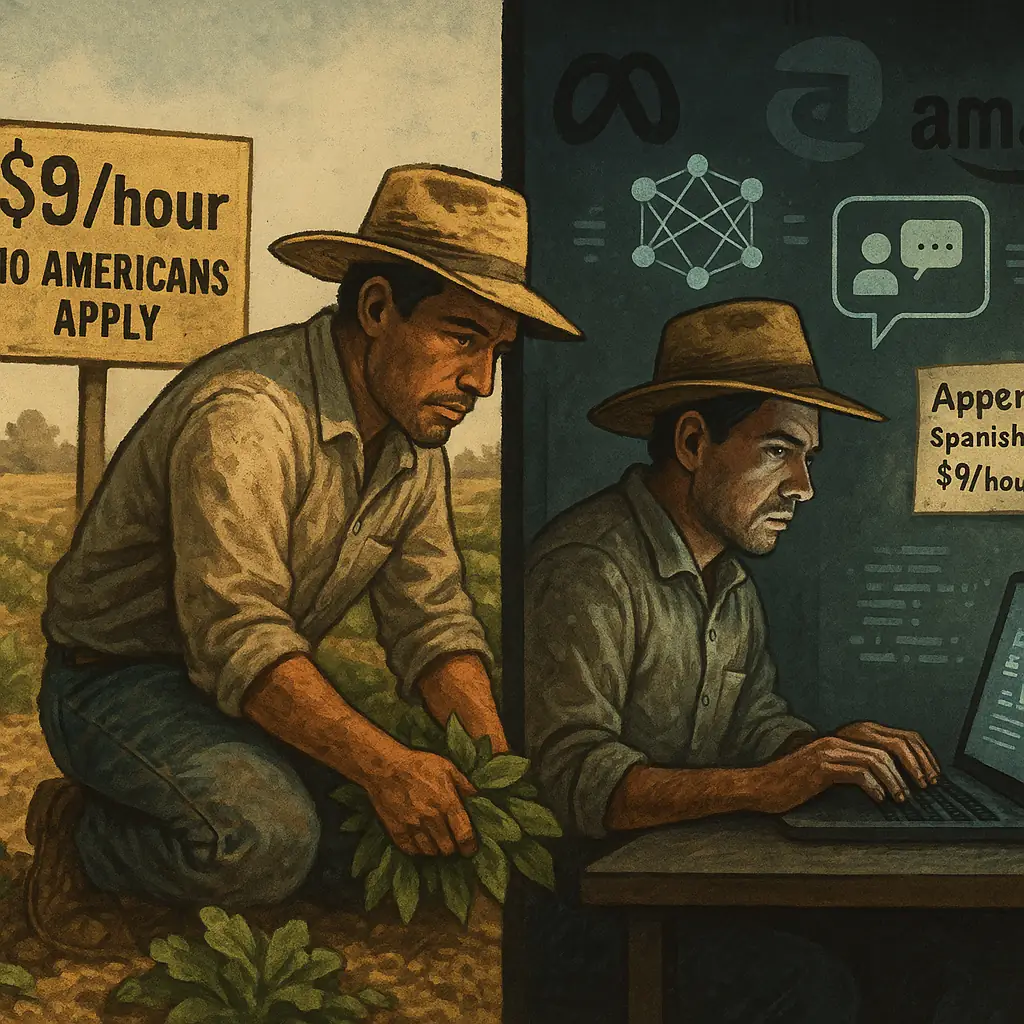
It's a common narrative on the right: illegal immigrants are taking American jobs. But wait—let's take a step back and think critically about that, because it is cheap demagoguery at its worst.
Out there, immigrants' only opportunity is too often to take on low-tech jobs that most Americans refuse to do.
And here's the part that the fairy tale of illegal immigrants conveniently leaves out: tech giants in the AI velvet underground are frequently paying those very same low-tech, nine-dollars-an-hour-or-less wages to contractors, immigrant and native-born alike, all while marketing the work as cutting-edge and high-tech.
The AI Elite
Take Appen, for one. Appen has a Spanish-language side and pays contractors as little as $9 an hour—or less—to train chatbots for tech giants like Amazon. Think about it: what teacher fleeing Honduras wouldn't jump at the chance to earn $9 an hour without even needing to revalidate a degree, especially when that's likely much more than they could ever make back home? That appeal is exactly what makes the arrangement work for the platforms—and exactly what makes it worth scrutinizing, regardless of who ends up doing the work. All the while, some politicians and media personalities keep pushing a misleading narrative about job theft.
This phenomenon is what researchers like Mary Gray and Siddharth Suri refer to as ghost work —invisible, undervalued human labor behind AI.
As Rest of World has reported, similar exploitation plays out across Latin America, Africa, and Asia—this isn't just a South Florida problem; it's a planet Cloud problem.
The mechanism that makes this possible isn't just wages—it's classification. Appen and similar platforms hire contractors as independent 1099 workers rather than employees, and U.S. and Florida minimum-wage laws apply to employees, not independent contractors. That distinction lets platforms legally pay rates that would be flatly illegal for an employee doing the same work, on the same schedule, under the same supervision. It's the loophole underneath the ghost-work economy, and it isn't an oversight in how these platforms pay people—it's the business model.
In fact, when politicians and often self-proclaimed influencers cry foul over immigrants taking American jobs, they're conveniently overlooking the role tech giants play in creating a system that pushes those very immigrants—and native-born workers alongside them— into a gig economy structured to sidestep the labor protections that would apply to a traditional job.
Low-wage job providers hardly have the money and influence that high-wage job providers do. So, if there's anyone to blame, they'll be the first in line—even when the underlying structure was built by someone else.
A Troubling Encounter with AI's Corporate Reality
Before digging deeper, it's important to clarify that this isn't about the treatment of illegal immigrants in low-paying jobs—a world where rights are often nonexistent and exploitation runs unchecked. Instead, we're examining the reality faced by contractors working for Appen, a seemingly reputable company in the tech sector, where labor dynamics bear an unsettling resemblance to those harrowing conditions.
In September 2024, Appen transitioned to a platform called CrowdGen—with no prior announcement, apparently unprepared and barely tested.
Appen promised improved AI capabilities and cutting-edge efficiency, but the shift felt more like opening Pandora's box.
Rather than streamlining processes, CrowdGen unleashed a wave of confusion and technical glitches that, of course, hit the poor at the bottom of the corporate ladder—the contractors, who are too far removed from decision-makers to matter.
Contractors were caught off guard by the change, receiving little to no communication about how it would affect their ongoing projects. While CrowdGen is advertised as a technological leap forward, it has done little to alleviate existing frustrations—if anything, it has only added to them, creating new obstacles that make it even harder to deliver quality results.
High-Tech Image, Low-Tech Tools, and Lower Pay
While Appen's projects focus on utilizing advanced AI technology, contractors are met with a very different reality.
Take the SRT platform, for example, where much of the work involves tasks related to Facebook. The official headline for SRT reads:
Thank you for helping to protect Meta's platforms.
Yet this critical work pays only $9 to $11 per hour. For context, Florida's minimum wage was $13.00 per hour as of September 30, 2024, rising to $14.00 on September 30, 2025, and on a path to $15.00 by September 30, 2026, under the state's voter-approved schedule. So this isn't just below a livable wage—contractor pay sits meaningfully below what Florida law requires for employees doing comparable work, a gap that exists only because these workers are classified as contractors rather than employees. It's also well below what a part-time employee with relatively little training could make flipping burgers at McDonald's or stocking shelves at Publix—jobs where that minimum-wage law actually applies.
The message is clear: even the responsibility of protecting Meta's platforms isn't treated as work that deserves the same baseline protections as flipping burgers—because, on paper, it isn't classified as that kind of work at all.
In conclusion, while contractors at Appen and similar platforms play a crucial role in advancing AI and supporting major tech giants, they are often compensated below a livable wage. Despite the promises of flexible work and cutting-edge technology, the reality is that workers are trapped in a system that exploits their labor without offering fair compensation or respect for their contributions.
In other words, in a perfect AI world, a contractor spending 40 hours a week keeping Facebook safe would walk home with around $1,200 a month after paying their 1099 obligations. Good luck covering basic living expenses in Florida!
Final Thoughts
Appen and its clients, including Meta, must address these shortcomings if they wish to bridge the gap between innovation and reality. High-tech aspirations lose their meaning without fair pay, reliable tools, and transparent systems. According to the Mozilla Foundation , ethical AI must start with how it treats the humans behind it.
The old excuses about job scarcity and cost no longer hold water in today's interconnected economy. Companies like Appen know exactly where their contractors are located and could tailor compensation to reflect local cost of living—or, at minimum, stop relying on contractor classification to avoid minimum-wage obligations altogether. According to the Fairwork Foundation , which evaluates gig platforms globally, many fail to meet even the most basic standards of fairness.